




2003 September
March 17, 2005
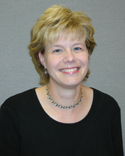
From the President
September 2003
 It
hardly seems possible that summer is over and we're already into
the swing of a new academic year. Each new year brings challenges,
but also opportunities. Within our state and regional associations,
we will be given several opportunities for professional growth and
development. As budgets become tighter, I know it's tempting to cut
expenses by eliminating travel and sacrificing training events and
conferences. At the same time it is because of the unique
challenges of these times that each of us are called on to be even
more creative in how we approach our work. Our professional
associations provide wonderful opportunities for new ideas,
networking with colleagues and professional rejuvenation, all
critical to our being at our very best. So, with that in mind, I'd
like to remind you of the opportunities available to us this next
year.
It
hardly seems possible that summer is over and we're already into
the swing of a new academic year. Each new year brings challenges,
but also opportunities. Within our state and regional associations,
we will be given several opportunities for professional growth and
development. As budgets become tighter, I know it's tempting to cut
expenses by eliminating travel and sacrificing training events and
conferences. At the same time it is because of the unique
challenges of these times that each of us are called on to be even
more creative in how we approach our work. Our professional
associations provide wonderful opportunities for new ideas,
networking with colleagues and professional rejuvenation, all
critical to our being at our very best. So, with that in mind, I'd
like to remind you of the opportunities available to us this next
year.
RMASFAA Fall Conference
Big Sky, Montana, will be a beautiful location for this year's
conference which will be held October 5th through 8th.
Registrations are being accepted through September 20th.
NeASFAA Support Staff Workshop
This is a wonderful opportunity to show our support staff how much
we appreciate what they do - and how lost we'd be without them!
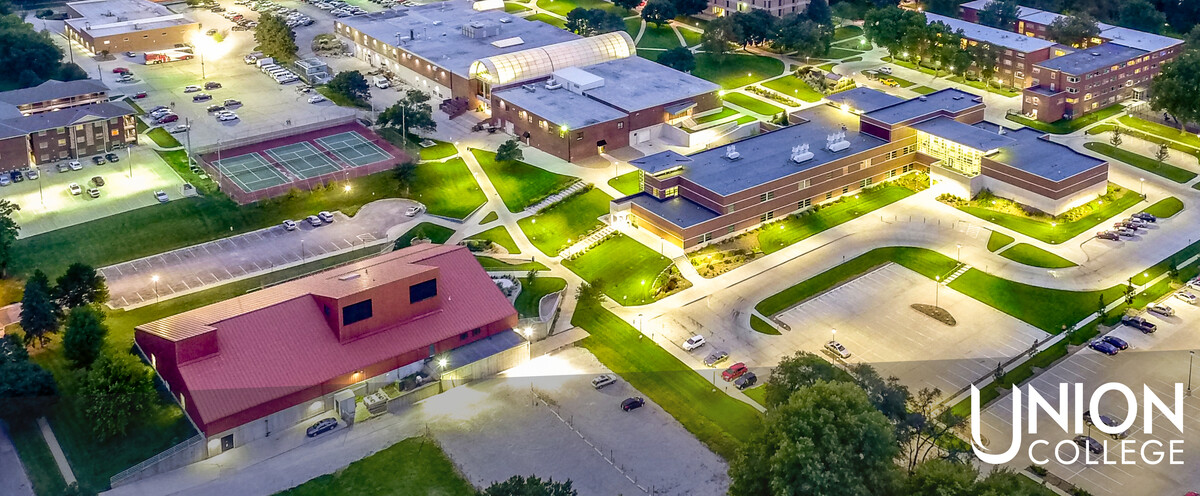
This year's workshop will be held in Lincoln at Union College on
Friday, October 10th.
NeASFAA Fall Institute and RMASFAA Decentralized
Training
Focusing on the "nuts and bolts" of our day to day
responsibilities, these training events will be held November 5th
through 7th at the Cornhusker Hotel in Lincoln. The topic for
Decentralized Training is student eligibility.
NeASFAA Spring Conference
This conference serves as a great opportunity to grow
professionally, while giving us the chance to network with our
colleagues. Our Spring Conference will be held April 14th through
16th at the Sandhills Convention Center in North Platte.
One additional opportunity that we'll have this year is to offer our opinions in the Reauthorization process. As I receive information from NASFAA and RMASFAA requesting our input regarding various proposals, I will be sure to pass that information on to you.
Thank you for your continuing support of NeASFAA and I wish you all a very successful year!
Deana
News Room
Nelnet Presents
First Quarterly Full Circle Award to Robert D. Walker of Creighton
University
(Lincoln, NE) – In a brief awards ceremony held on June 27, 2003,
Robert D. Walker, Director of Financial Aid for Creighton
University in Omaha, Nebraska, became Nelnet's (National Education
Loan Network) first recipient of the Full Circle Award, an award
designed to recognize Financial Aid Officers who go above and
beyond their daily tasks to invest in each student and their
specific concerns.
"Bob epitomizes everything good about a financial aid professional. He is caring, honest, empathetic, fair, loyal, and very bright," said Kathy McConnell, Vice President of ASAP/Union Bank & Trust, who submitted Mr. Walker's nomination to Nelnet. "Bob expects the best from everyone who works for him and also demands no less of himself. He expects students to take responsibility for their financial situation, but is always there to provide a helping hand if needed."
Mr. Walker has been at the forefront of financial aid change for 23 years, has served in numerous leadership capacities at the state and regional level, and has actively participated on several national professional committees. He is currently a member of RMASFAA (Rocky Mountain Association of Student Financial Aid Administrators), NASFAA (National Association of Student Financial Aid Administrators), an avid community volunteer, and the recipient of numerous prestigious awards.
"I have always been impressed with the helpfulness, sharing, and camaraderie of the financial aid community," stated Mr. Walker. "By providing excellent customer service, we enable students and parents to avoid worrying about financing as much as possible."
"Making educational dreams possible can be a complex journey, and the financial aid office is often where students take their first step. Mr. Walker is an example of someone who gives students clarity and direction in the realm of education finance," commented Don Bouc, President of Nelnet Corporation and the company's chief spokesperson.
Nelnet is a vertically integrated educational finance organization dedicated to providing products and services that facilitate education finance for students, schools, and lenders. With over $10 billion in total assets, Nelnet originates approximately $3 billion for itself and its service partners annually, including consolidation loans, and services, or provides servicing software for, more than $46 billion in student loans. Nelnet ranks among the nation's leaders in terms of total student loan assets managed.
Additional information about the Full Circle Award is available at www.nelnet.net.
University of Nebraska Medical Center receives learning materials for Community Academy from Union Bank & Trust

CPR manikins, a video camera, and career assessment devices are just a few of the new tools for learning that are now contained within the UNMC Youth Learning Center on the campus of the University of Nebraska Medical Center. These tools could not have been purchased without the generous support of the Union Bank and Trust company.
During the End of the Session Breakfast of the UNMC Community Academy, Ms. Kathy McConnell, Vice President Student Loan Marketing, Union Bank and Trust, was honored by the youth and their families for her historical support of students who attend programs at the Youth Learning Center.
The UNMC Community Academy, housed in the Youth Learning Center and administered by UNMC's Student Services Division, was founded in 1999 and is dedicated to stimulating an interest in health care and health careers among youth in the community who might not have an opportunity to be exposed to such issues.
The multicultural learning environment engages these youth with the faculty and programs of the University of Nebraska Medical Center. Students also receive First Aid, CPR, and AED certifications. An important element of the program is to teach youth about the needs of their community through volunteer activities with community agencies.
Community leaders, like Ms. Kathy McConnell, have demonstrated that lending institutions can play a vital role in cultivating a broad spectrum of young citizens who, even at this stage of their development, are making important contributions to the communities in which they live.
In the words of one Community Academy participant, "we would like to thank the Union Bank and Trust for their generous donation and, as you can see, we put it to great use."
Keeping
Students in School Has Historically Helped Avert
Default
Kent Wolfe
NSLP Research
September is the time of year that lenders, schools and guarantors anticipate the release of the official cohort default rates. These rates can tell many things to the higher education community; for example, whether there was improvement over the prior year's rate or how rates compare among peers.
Despite the value derived from this data, this measuring stick does have a limitation. Rate calculations consider loans that entered repayment up to three years earlier, which means that rates tell how effective default prevention efforts were in the past - not necessarily today.
Being proactive, Nebraska's higher education community takes into account numerous factors, in addition to default rates, when designing default prevention programs. Two of the many factors that NSLP has monitored are the relationship between student loan indebtedness and default and the relationship between persistence and default.
Since the fiscal 1996 cohort year, NSLP has found that increasing loan balances do not translate to increased default but rather that default tends to decline as student loan balances increase. To show this ongoing trend among Nebraska students, the following chart has combined the past three cohorts for NSLP's Nebraska college and university students.
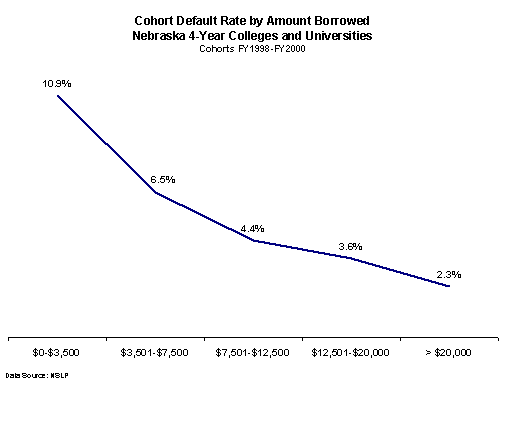
This does not mean that heavier borrowing is necessarily better.
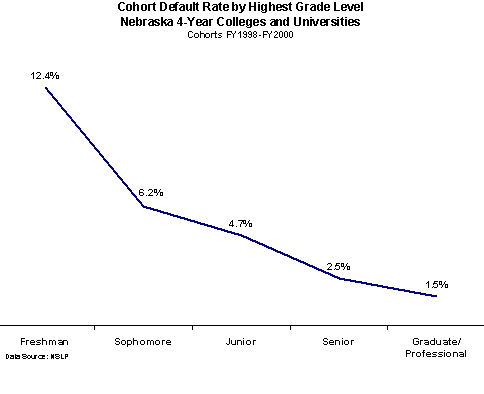
What it does suggest is that staying in school, and thereby
borrowing more, leads to improved loan repayment. The following
chart shows that default rates tend to be lower as grade level
increases.
Schools, lenders and guarantors are finding out this month what
their official default rates are for fiscal 2001. This new
information will likely lead to the assessment by many of their
default prevention efforts. Regardless of what a specific default
rate is, one can be reasonably assured that helping students remain
in school can be factored into any successful default prevention
plan.
Historically Black Colleges and Universities To Benefit From New Partnership
Washington, D.C. (July 7, 2003) – The National Association of Student Financial Aid Administrators (NASFAA) and the Kentucky Higher Education Assistance Authority (KHEAA) today announced a pilot partnership to provide peer reviews for Historically Black Colleges and Universities (HBCUs) under NASFAA’s Standards of Excellence Review Program.
The Standards of Excellence (SOE) Review Program, now in its fifth year, is an objective, confidential peer review program that assesses an institution’s delivery of financial aid. Customized and confidential, the on-site reviews are designed to highlight strengths and recommend improvements.
“KHEAA sees great benefit to both institutions and students in the Standards of Excellence Review Program,” said KHEAA Executive Director Joe L. McCormick. “Identification of best practices as well as opportunities to fine-tune operations is particularly important in averting student loan defaults, which is one of KHEAA’s top concerns.”
Under the terms of the partnership, KHEAA will subsidize the full cost associated with each SOE review at selected HBCUs.
NASFAA President Dallas Martin remarked on the timeliness of the NASFAA-KHEAA agreement. “We recognize that these are difficult financial times for postsecondary institutions, and are delighted that KHEAA has stepped forward to help provide this valuable service for schools that might otherwise not be able to afford it.” Martin noted that NASFAA would continue to seek partners to help finance SOE reviews at additional institutions in all sectors. “We plan to reach out to a variety of organizations that recognize the value of the SOE program and seek their assistance in providing reviews at all kinds of institutions,” Martin said.
How the Standards of Excellence Review Program Works
- The scope of the review is established in a letter of engagement between the institution and NASFAA.
- The institution submits demographic data and other information to NASFAA and a preliminary institutional assessment is conducted.
- NASFAA then selects a customized peer review team comprised of experienced financial aid administrators who visit the institution and perform an in-depth, on-site review of the financial aid operations. The review team spends two days to one week on the campus.
- Following the on-site review, the team compiles an objective evaluation of the institution’s financial aid program and presents its findings in an exit interview to administrators designated by the institution.
- Finally, the peer review team prepares and submits a confidential written report that identifies the institution’s good financial aid practices, cites any compliance issues, and suggests improvements.
History of the Standards of Excellence Review Program
The Standards of Excellence Review Program grew out of recommendations from the NASFAA Task Force on Institutional Leadership co-chaired by John T. Casteen III, president of the University of Virginia, and Rhonda D. Norsetter, special assistant to the chancellor at the University of Wisconsin-Madison. In its report, the task force noted that “student financial aid is a matter of urgent concern to institutions, policy makers, and to the nation,” and that “colleges and universities face serious challenges in this area.”
In a letter to college presidents about the review program, Dr. Casteen warned that “poorly managed financial aid programs can hamper enrollment efforts, cause rifts among campus offices, expose the institution to significant financial liability, and sabotage efforts to serve student and their families.” But, he continues, “Financial aid programs that are integrated into institutional planning and soundly managed can help advance institutional goals.”
For more information on the Standards of Excellence Review Program, visit www.NASFAA.org/SOE.asp or contact Program Director Judy Schneider at (202) 785-0453, ext. 144 or schneiderj@nasfaa.org .
HBCUs seeking subsidized reviews under the NASFAA-KHEAA partnership program should contact Schneider directly.
Organizations interested in providing financial support to enable SOE reviews at postsecondary institutions, in any sector, should contact NASFAA Vice President Tim Christensen at (202) 785-0453, ext. 146 or christensent@nasfaa.org .
The National Association of Student Financial Aid Administrators (NASFAA) is a nonprofit membership organization that represents more than 10,000 financial aid professionals at nearly 3,000 colleges, universities, and career schools across the country. Based in Washington, D.C., NASFAA is the only national association with a primary focus on student aid legislation, regulatory analysis, and training for financial aid administrators. Each year, members help more than 8 million students receive funding for postsecondary education. For more information, visit www.NASFAA.org.
KHEAA is a public agency created by the Kentucky General Assembly and serves as the federally designated guarantor of Federal Family Education Loans in two states; administers a variety of other federal and state student aid programs; provides a multiplicity of customer-friendly services for students, schools, and lenders; and collaborates with like-minded organizations to promote innovative techniques, products, and services.
Is "Integrity"
Even an Issue?
By Dan Brent
Citibank
Time was when integrity was not even an issue in business. It was a given - unnecessary even to mention. The used car salesman who lied about the mileage or history of the car was a joke of legend. Then along came Enron and a parade of other companies indicted for cooking the books. Now there is a super-consciousness about integrity issues.
We get messages from our CEO with some regularity reminding us that any stretch of ethics or rules is unacceptable and will not be tolerated. I expect this happens now in most organizations. If you don't get similar messages from your president or boss, it's because they consider it unnecessary. Breaches of integrity are considered unimaginable in your setting.
But . . .
I once worked as Director of Operations in a branch office of an insurance company. My boss one day asked me to send a note to everyone insisting that no circumstance justified forging a signature. Apparently he'd become aware that, to save either a long trip or a delay, an agent had, with a client's permission, signed his signature. "Tell them," my boss explained, "that any breach of this rule will result in dismissal and loss of license." I drafted the message, signed his name to it as I often did with internal memos, and made copies for everyone. Before I circulated it, the silliness of my behavior struck me. I had forged his signature under the "no forging" message!
I consider myself an ethical person. I'm the first to say "Tisk, tisk" when I hear or read about business shenanigans. But this humbling experience was a lesson to me. Even with good intentions, it is easy to be blind to the corner-cutting in one's own behavior. It's like the worm that creeps into your computer. All is well and then suddenly, silently, there is the problem.
Financial Aid people work in a glass house. Their decisions are pretty much public record. Students compare notes. The school, the guarantors, the banks - everyone is looking over your shoulder and keeping score. That's probably a fairly effective deterrent to skipping steps or cutting corners. But then it's useful to remember that the corporations have watchdogs too. Board members, stockholders, Wall Street gurus, outside auditors, inside whistle-blowers, government agencies, and customers all have an eye on what's happening. Yet, at least for a while, some corporations were able to hoodwink all of them.
So, at the end of the day, it's the integrity of the people on the spot that is the final defense for honesty.
Kouzes and Posner have written several books on business and leadership behaviors. In Credibility (1993) they make the point that leaders can't do one thing and expect something different from their people. The reader nods his or her head knowingly and agrees, perhaps without reflecting that the principle applies with equal strength to one's own behavior. If we want students to behave with integrity, for example, they must see integrity in our behavior. They may not appreciate the bottom line of a decision we make. But if it is made with integrity, there is a longer-range lesson that is more valuable than the immediate, disappointing effect. Integrity counts.
In his Seven Habit of Effective People book (1990), Stephen Covey suggests writing out what you'd like to have said at your funeral. The thought is a bit gauche but you can see the value of where he's going. I think I'd like the word "integrity" to appear there somewhere. You?
Dan Brent is a Professional Development Officer with Citibank. He regularly presents seminars for Financial Aid people.
Financial Aid Administrators Present Awards At 2003 NASFAA Conference
(Washington, D.C.) - At its annual conference last month in Salt Lake City, the National Association of Student Financial Aid Administrators (NASFAA) presented its highest honors.
- RICHARD TOMBAUGH was presented with a Lifetime Achievement
Award, the highest award NASFAA can bestow on one of its
Members. Tombaugh served as the first executive director of the
NASFAA Washington office from 1970-1975. An expert on the
principles and mechanics of every phase of the student aid process,
his representation of NASFAA before the Congress and with the U.S.
Department of Education proved of great value to the profession. A
colleague observed that Tombaugh’s greatest contribution during
NASFAA's early years was helping to build and operate the fledgling
Association. Without his efforts, it is doubtful that NASFAA would
have survived its humble beginnings.
- KENNETH WOOTEN also was honored with a Lifetime Achievement
Award. Wooten gained national prominence among college aid
professionals in 1969, when he served as the president and one of
six founders of NASFAA. For 31 years, Wooten served the University
of Mississippi diligently as a counselor, director of placement and
financial aid, and finally as registrar and dean of admissions
until his February 1991 retirement. He also served as a consultant
for the U.S. Department of Education, the U.S. Justice Department,
and several Mississippi junior colleges. His vision helped create
some of the Association’s most enduring products and services,
including the NASFAA Newsletter.
- CHARLES W. BRUCE received the Distinguished Service
Award for outstanding achievements in furthering NASFAA’s
goals. Bruce served as NASFAA’s national chair from July 1, 2002 to
June 30, 2003. His thoughtful and deliberative leadership coupled
with his commitment to “opening doors of educational opportunity”
helped the Association formulate a balanced and rational set of
public policy positions for the upcoming Reauthorization of the
Higher Education Act.
- JACQUELINE KING, director of the American Council on Education's Center for Policy Analysis, was awarded the Robert P. Huff Golden Quill Award for her outstanding contributions to the body of literature on student financial aid. Of particular importance are Kings’ two recent publications: Crucial Choices: How Students' Financial Decisions Affect Their Academic Success and 2000 Status Report on the Pell Grant Program. She also edited the book Financing a College Education: How It Works, How It's Changing. King has contributed greatly to NASFAA's research activities, including writing for the Journal of Student Financial Aid and Student Aid Transcript magazine.
The following six individuals received NASFAA’s State and Regional Leadership Award for their outstanding contributions at the state and regional levels.
- MICHAEL BENNETT, director of financial aid at Brookdale
Community College in New Jersey, Eastern Association of Student
Financial Aid Administrators (EASFAA).
- ADDALOU DAVIS, director of financial aid at the University of
the Pacific, McGeorge School of Law, in California, Western
Association of Student Financial Aid Administrators (WASFAA).
- PAM FOWLER, director of financial aid at the University of
Michigan, Midwestern Association of Student Financial Aid
Administrators (MASFAA).
- CAROL MOWBRAY, director of student financial aid and support
services at Northern Virginia Community College, Southern
Association of Student Financial Aid Administrators (SASFAA).
- MARY SUE RIX, director of financial aid at Centenary College of
Louisiana, Southwestern Association of Student Financial Aid
Administrators (SWASFAA).
- SUE WEINREIS, assistant director of financial aid at Montana State University -Billings, Rocky Mountain Association of Student Financial Aid Administrators (RMASFAA).
The National Association of Student Financial Aid Administrators (NASFAA) is a nonprofit membership organization that represents more than 10,000 financial aid professionals at nearly 3,000 colleges, universities, and career schools across the country. Based in Washington, D.C., NASFAA is the only national association with a primary focus on student aid legislation, regulatory analysis, and training for financial aid administrators. Each year, Members help more than 8 million students receive funding for postsecondary education.
Committee Corner
September 2003
MEMBERSHHIP COMMITTEE
by Wendy Olson
 Hello
from the Membership Committee! The new year's invoices and
information forms have been sent, and many have been returned (If
yours hasn't, you should be getting a letter from me shortly.).
Some wondered why we asked for some fundamental information again.
I found there was some updating to do as far as new people, new
names, and even new web and e-mail address information, so what
better time to gather that. We will notify you once the directory
has been updated.
Hello
from the Membership Committee! The new year's invoices and
information forms have been sent, and many have been returned (If
yours hasn't, you should be getting a letter from me shortly.).
Some wondered why we asked for some fundamental information again.
I found there was some updating to do as far as new people, new
names, and even new web and e-mail address information, so what
better time to gather that. We will notify you once the directory
has been updated.
The committee met and began conversations of projects for the year. We are sticking with the oldies but goodies (membership enrollment and Newcomer's Welcome), and have discussed some new projects (directory information database for mailings and new photo directory photos). Trust me when I say, that there is plenty to get done this year, and we are working hard to get it all done!
Plan on seeing us out and about as the Fall Institute approaches welcoming our new comers, and maybe even asking you for your new mug-shot (photo for the directory)!
Best wishes as you begin the new school year!!
On a related membership note, I am happy to tell you that Tamie Sovereign has made the big move home! Cards and letters can be sent to her at:
5710 W. South Airport Road
Norfolk, NE 68701
I am sure she would enjoy hearing from you!
AWARDS COMMITTEE
by Joan Jurek
 The Awards Committee has
started planning for the Support Staff Workshop and fall
conference. We had our first meeting Tuesday, August 12th in
Lincoln. Our members are watching you! As in past years we want to
recognize the most memorable moments of you and your
colleagues.
The Awards Committee has
started planning for the Support Staff Workshop and fall
conference. We had our first meeting Tuesday, August 12th in
Lincoln. Our members are watching you! As in past years we want to
recognize the most memorable moments of you and your
colleagues.
Recently, you may have been contacted by Kathy McConnell as she searched for specific information about you and/or your support staff; this information is important as we plan ahead, so we appreciate your quick response. If you have not had a chance to respond to Kathy's e-mail, please do by October 1st. Don't let your staff be overlooked simply because you are too busy to respond!
The Awards Committee needs your help to discover all those selfless deeds or just plain funny situations involving our NeASFAA friends. Spread the word! Let us know about anecdotes, true-life tales, or random acts of kindness that you have observed. E-mail your recommendations to any of the following committee members:
Joan Jurek, Chair - joanj@educationquest.org
Kathy McConnell, Vice-Chair - kmcconnell@asapubt.com
Kay Dinkelman - kdinkelman1@unl.edu
Amy Lyons - alyons@fs1.dana.edu
Steve Millnitz - smillnitz@cccneb.edu
Bobbi Pettinger - bobbipet@aol.com
Tammi Preston - tammip@educationquest.org
PROFESSIONAL DEVELOPMENT
COMMITTEE
by Mark Krings
 The Professional
Development Committee continues to work hard putting together
programs for the coming year. Take a look at the upcoming events
and make sure to mark your calendar accordingly.
The Professional
Development Committee continues to work hard putting together
programs for the coming year. Take a look at the upcoming events
and make sure to mark your calendar accordingly.
Support Staff Workshop will take place at Union College in Lincoln on October 10th. Registration will be available on-line and via the mail in early September. We have a full agenda that will benefit all. Please consider sending your support staff for a day of education and fun.
NeASFAA Fall Institute will be held at the Cornhusker hotel in Lincoln November 5-8. Based on feedback received from our members the past few years, we are planning to adjust the schedule of events.
We will begin with the NSLP update the morning of the 5th, but instead of moving into Decentralized training, we will move directly to the Fall Institute on the afternoon of the 5th and run through the morning of the 6th. Decentralized training will begin on the afternoon of the 6th and run through the morning of the 7th.
If you have suggestions for topics discussions, please let me know and keep an eye out for registration materials coming later this fall.
NeASFAA Spring Conference will take place at the Sandhills Convention Center in North Platte Nov 14-16. We will provide more details in future NeASFAA Newsletters and via the NeASFAA listserv.
COMMUNICATIONS COMMITTEE
by Stacey Musil
 Communications is working hard
to have a new website design completed and live by October. This
includes a new look for NeASFAA News. Watch for an official
launch date!
Communications is working hard
to have a new website design completed and live by October. This
includes a new look for NeASFAA News. Watch for an official
launch date!
Be sure to read the "Leadership Book Review" article in this edition of NeASFAA News brought to you by Christine Denicola of our committee. We have purchased several copies to be given away at Fall Institute. Must be present to win, so hope to see you there!
Please contact any of the following committee members with any
communication needs.
Peggy Tvrdy - ptvrdy@southeast.edu
Brigid Vail - bvail@unl.edu
Christine Denicola - christined@educationquest.org
Heather Doe - hdoe@studentloan.org
Melinda Hogeland - melindah@educationquest.org
Stacey Musil - staceym@fes.org
GETTING TO KNOW...
Kyle Rose
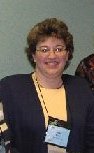 "I was born in Oakland, Iowa, and
came to Wayne to attend college in 1972. Little did I know then
that I would end up spending the rest of my life in Wayne. I
married my husband, Dan, in 1974 and worked at the college until he
finished his degree in December of 1975. We then moved to McCook,
NE, for 1 1/2 years, returning to Wayne in the fall of 1977. I
started working at WSC in the College Relations Office and then
moved to the Financial Aid Office in 1980 becoming Director in
1999.
"I was born in Oakland, Iowa, and
came to Wayne to attend college in 1972. Little did I know then
that I would end up spending the rest of my life in Wayne. I
married my husband, Dan, in 1974 and worked at the college until he
finished his degree in December of 1975. We then moved to McCook,
NE, for 1 1/2 years, returning to Wayne in the fall of 1977. I
started working at WSC in the College Relations Office and then
moved to the Financial Aid Office in 1980 becoming Director in
1999.
Dan owns Tom's Body & Paint Shop here in Wayne--a family owned business since 1976. We have two daughters. Megan is married. She and her husband live and work in Wayne. Marisa is a high school senior so we're looking at colleges. Marisa was an exchange student in Taiwan last year so she's ready for a new adventure with college.
In my spare (??) time, I enjoy spending time with my family. And watching NASCAR!! I became a huge NASCAR fan several years when I surprised my husband with tickets to the Brickyard 400 in Indianapolis. I'm a bigger fan than he is. So don't call me on Sunday afternoon--I'll be in front of the TV watch cars drive around in circles!
I enjoy being able to help a student achieve their dream of graduating from college. It's especially rewarding when I am explaining something to a student that they don't quite grasp and then you can actually see the "light bulb" turn on in their head."
Movers & Shakers
The following stories are the latest in an ever changing Nebraska world of financial aid.
 Weather: Blue and
Overcast (Boy, are we blue about departures):
Weather: Blue and
Overcast (Boy, are we blue about departures):
911 (Get it she is going to be a nurse!) Departure at Hastings
College!! Mary Conn has been a Financial Aid
Counselor for 15 years. "Mary is saying farewell in order to pursue
her goal of becoming a registered nurse." reports Terri Graham.
Best of luck to Mary!
 News: (New faces
sighted in FA offices):
News: (New faces
sighted in FA offices):
Hastings isn't shorthanded for long, Mary's position has been
filled by Dana McCammon. Her new boss Terri Graham goes on
to say "Dana comes with all kinds of financial aid experience,
having worked formerly at Dodge City Community College, the
Oklahoma Guaranteed Student Loan Program, and Sallie Mae/Lawrence,
KS. She and her husband, Ryan, moved to Hastings in September 2002.
Ryan is a Senior Forecaster at the National Weather Service. Dana
and Ryan have three dogs and two cats. She reports that she is
THRILLED to be back in Financial Aid. We are thrilled to have
her!"
This just in. . .Krista Barr has joined the staff at Bellevue University. Krista joins the office as a Financial Aid Counselor. Hello Krista!
Stacey Musil has accepted a new position as FES Business
Development Representative! Now don’t get all worried that she
won’t continue her reign as the great NeASFAA Webmaster, because
even though her title and responsibilities have changed, she will
still continue to support NeASFAA.org with her magic computer
touch. Way to go Stacey!!
 Celebrity News:
Tammy Gay from the Region VII office of the US Department of
Education reports the Direct Loan School Relations Office has
officially changed its name and its role to ED's FSA School
Relations Office. "Our role has expanded to include support in all
Title IV programs for all schools, non-DL as well as our DL
clients. Any Financial Aid Officer who has questions and would like
to talk to a person in the Kansas City Regional offices is invited
to give us a call. We'll do our best to help resolve issues and
answer questions. If we cannot resolve the issue or do not have the
answer, we will find the answer or put the caller personally in
touch with someone who can."
Region VII's FSA Office address and phone numbers: 8930 Ward Parkway, Ste 2028, Kansas City, MO, Case Mgmt & Oversight: (816)268-0410, School Relations (816)268-0444
NSLP Update
September 2003
UNK
Presents Loan Forgiveness Information At NASFAA
by Mark Krings
Regional Director
National Student Loan Program
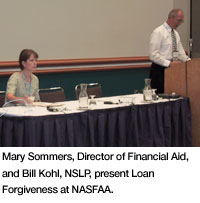 Mary Sommers of
University of Nebraska-Kearney and Bill Kohl, NSLP's Vice President
of Operations, delivered a presentation about July 1 regulations
affecting loan forgiveness, discharge, and cancellation benefits.
Schools also learned how to help their students take advantage of
them.
Mary Sommers of
University of Nebraska-Kearney and Bill Kohl, NSLP's Vice President
of Operations, delivered a presentation about July 1 regulations
affecting loan forgiveness, discharge, and cancellation benefits.
Schools also learned how to help their students take advantage of
them.
UNK uses NSLP's Teacher Loan Forgiveness brochure at http://www.nslp.org/pdf/teacherbrochureNov01.pdf to inform students who are preparing to be teachers how to have their student loans forgiven. The brochure outlines which loans may be forgiven, how to apply, which application to use, and how loan payments may be postponed while teaching.
NSLP's Repayment Assistance webpage at http://www.nslp.org/repay.htm helps students learn about forgiveness, discharge, and cancellation. Students pursuing teaching degrees can go to the website and find information, application and forbearance forms, and a list of low-income schools eligible for Stafford loan cancellation.
You can order Teacher Loan Forgiveness brochures from the Order Products Online section of NSLP's website at http://www.nslp.org.
NSLP
Colleagues 'Flock' To NASFAA Reception
by Mark Krings
Regional Director
National Student Loan Program
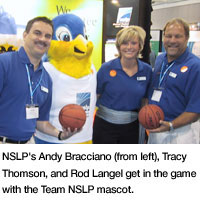 Schools and lenders
'flocked' to NSLP's reception for a break from the busy NASFAA
conference and were greeted and entertained by NSLP's bluebird
mascot. "It was great to see so many of our Nebraska colleagues,"
said Rod Langel, Vice President of Business Development. "The
reception gave us a chance to visit one-on-one with our valuable
customers."
Schools and lenders
'flocked' to NSLP's reception for a break from the busy NASFAA
conference and were greeted and entertained by NSLP's bluebird
mascot. "It was great to see so many of our Nebraska colleagues,"
said Rod Langel, Vice President of Business Development. "The
reception gave us a chance to visit one-on-one with our valuable
customers."
Our Nebraska friends were also treated to a special dinner hosted by NSLP, EducationQuest Foundation, and the Foundation for Educational Services. Special thanks to Peg Sutter, Mark Krings, and Ryan Stamm for organizing a fabulous dinner.
USAFunds Update
September 2003
Loan-Consolidation Considerations
by Larry Viterna
USA Funds Services Regional Director
The record-low interest rates, effective July 1, on Federal Stafford and Federal PLUS loans, should prompt nearly every eligible borrower to investigate loan consolidation as a means to lock in these low rates for the remainder of their repayment term. Although loan consolidation may benefit many borrowers, they should understand the following ramifications before they submit their consolidation-loan applications:
Do you really want to be paying off your student loans when your children are in college? Loan consolidation permits a borrower to extend the repayment term up to 30 years, depending on the total outstanding balance of the borrower's education loans. For borrowers who cannot afford their monthly student-loan payments, this extended-repayment term can reduce their monthly installments. On the other hand, borrowers who have high balances and want to "refinance" their loans to take advantage of historically low rates could end up making consolidation-loan payments while they're paying for their children's college costs.
Lower interest rates don't necessarily mean lower total interest costs. Borrowers who consolidate to lock in a low interest rate and repay their loans over the extended period permitted by loan consolidation are likely to negate the benefits of the low rate. For example, a borrower who repays a $25,000 consolidation loan at 3.5 percent over a 20-year term pays approximately the same amount of interest as a borrower who repays $25,000 in unconsolidated Stafford loans over 10 years at a constant rate of 7 percent.
Balance affordable monthly payments against the shortest-possible repayment term. Many loan-consolidation promotions tout the benefits of reducing a borrower's student-loan payments by as much as 55 percent. This payment reduction can be a benefit for some borrowers. Borrowers who consolidate primarily to lock in low interest rates, however, should select the repayment term that produces an affordable monthly payment and repays the loan in the shortest-possible period.
Borrowers can lose some benefits when consolidating Perkins loans. Although federal law permits the consolidation of Federal Perkins loans, borrowers should be aware of some disadvantages. By consolidating, Perkins-loan borrowers give up the interest-subsidy benefit they receive if they qualify for deferment of their payments. In addition, Perkins borrowers may lose some loan-cancellation and deferment options by consolidating.
In-grace consolidation may be beneficial if you don't mind giving up the rest of your grace period. Borrowers who are in the six-month, post-school grace period and consolidate Stafford loans issued since July 1, 1995, can obtain a slightly lower consolidation-loan interest rate than if they wait until their loans are in repayment. These borrowers should understand, however, that by consolidating they give up the remainder of their grace period.
Loan consolidation is probably not a good idea for borrowers in the last year of repayment. Stafford-loan borrowers who are in the final year of their repayment term automatically receive the new, lower Stafford-loan rates effective July 1 through June 30, 2004. By consolidating, these borrowers are likely to receive a higher interest rate because the formula for calculating consolidation rates rounds the rate up to the nearest one-eighth of 1 percent.
Borrowers should consider additional issues regarding loan consolidation. Borrowers should ask if the lender offers consolidation-loan borrower benefits to further reduce interest costs. Borrowers should understand which organization will service their consolidation loan, where they will make payments and what level of customer assistance they can expect from the servicing entity. Borrowers also should find out if the lender offers an online-application process and how long it takes to process the application. In addition, borrowers should explore the level of loan-consolidation counseling they receive from the lender/servicer.
Quarterly Quote
September 2003
 "The future belongs to those who believe in the
beauty of their dreams."
--Eleanor Roosevelt
"The future belongs to those who believe in the
beauty of their dreams."
--Eleanor Roosevelt